

Read the SAFS 2025 Report
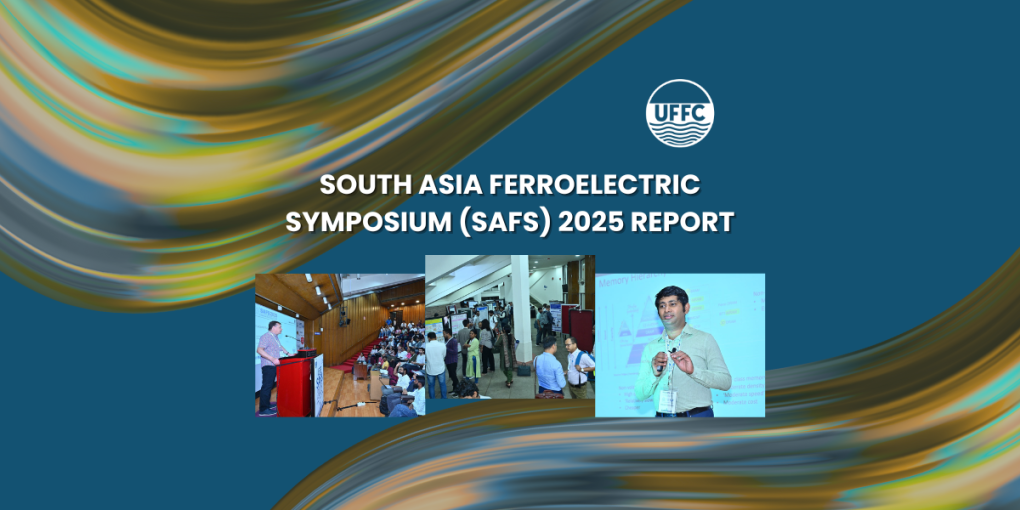
SAFS 2025 took place in Bengaluru, India, from August 6-8, 2025
Thanks to the funding from UFFC, the first South Asia Ferroelectric Symposium (SAFS) 2025 was held in Bengaluru, India during Aug 6-8, 2025. Rajeev Ranjan was the Chair and Pavan Nukala Co-Chair of the conference. Along with Rajeev Ranjan and Pavan Nukala, Bhagwati Prasad, Sujit Das and Gayathri Pillai formed the core team, which took care of the technical program, and all other organizational matters.
The conference was held at the National Science Seminar Complex (NSSC) of the Indian Institute of Science (IISc). The conference had 210 registered participants. It featured 5 plenary talks (Andrew J Bell (UK), Andrei Kholkin (Portugal), Umesh Waghmare (India), Uwe Schroeder (Germany), and Lane Martin (USA)), 49 invited talks, 15 young researchers' talks, 23 oral talks, and 85 posters. Two parallel sessions were held each day for the (non-plenary) talks.
A pre-conference tutorial was organized on Aug 5 for students. There were four tutorial lectures (i) Fundamentals of Piezoelectrics by Andrew Bell, (ii) Piezoforce Microscopy for Ferroelectrics by Andrei Kholkin, (iii) Ferroelectric and Multiferroic Devices by Bhagwati Prasad, and (iv) Ferroelectric Devices and Technology Integration by Veeresh Deshpande. Each tutorial session was for 90 90-minute duration. The tutorial sessions were attended by 100 + young participants (mostly students and postdocs). A networking pre-conference dinner was also held on Aug 5.
The student participants in the conference were from different regions of India, Myanmar, and France. In the invited/young/plenary categories, 48 speakers were from India and 22 from other countries (USA, France, Portugal, Spain, Germany, Taiwan, Korea, Italy, UK, Luxembourg, Japan).
Diverse themes: fundamental physics, bulk conventional ferroelectrics materials and devices, organic ferroelectrics, thin films, hafnia-based ferroelectrics, multiferroics, novel techniques, microelectronic devices, MEMS, etc.
To ensure maximum participation from the community, the organizers entertained all requests for waiving off the registration fees and, in some cases, even the accommodation charges. Almost all the participants were accommodated in the different guest houses around the venue. Breakfast, Lunch, evening tea/coffee, snacks, and dinner were served to all participants for free during the conference.
Apart from UFFC, the conference was also supported by funding from the Indian Institute of Science (IISc), and 12 other private sponsors.
Six awards were given for best oral presentations, and 22 awards for posters.
Almost all participants expressed appreciation for both the high-quality content presented during the conference and lauded the organizational effort that took care of the comfort of the participants. This sentiment was also echoed in the concluding remarks of Prof. Dragan Damjanovic, President of UFFC.