

The 19th Symposium on Piezoelectricity, Acoustic Waves, and Device Applications (SPAWDA 2025) Successfully Held in Shihezhi, China
Written By: Ji Wang
The Symposium on Piezoelectricity, Acoustic Waves, and Device Applications (SPAWDA) has been an annual event mainly for the Chinese community in piezoelectricity, ultrasonics, and device applications for two decades, with international participants. With the growth in academic research, the acoustic wave device industry, healthcare technology, and materials market, there are plenty of research and development activities for exchange. This has driven the SPAWDA for many years with broad participation from universities and industry, and the Symposium has also been regularly attended by international researchers and engineers.
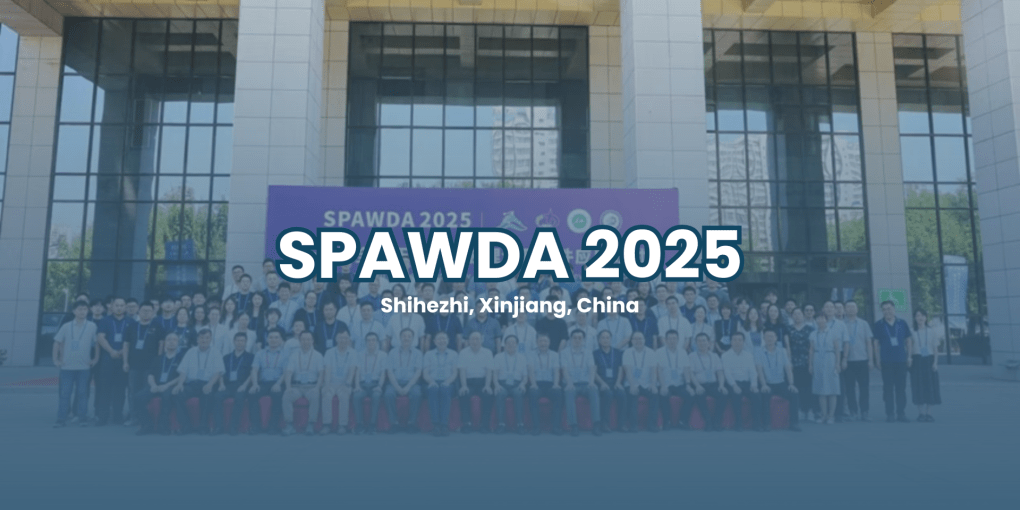
The 19th SPAWDA, jointly sponsored by the Chinese Society of Theoretical and Applied Mechanics (CSTAM), the Chinese Acoustical Society (ASC), and the IEEE UFFC Society, was successfully held from July 21 to 24, 2025, in the City of Shihezhi, Xinjiang, China, in the summer, departing from the usual winter occasion in years. The Symposium this year was organized by Shihezhi University, Shihezhi, Xinjiang, and Dongguan University of Technology (DGUT) in Guangdong Province.
As is tradition, the Symposium focused on the latest advancements in theories of piezoelectricity and wave propagation, ultrasonic detection and imaging, piezoelectric and ferroelectric materials, and the manufacturing technologies and applications of acoustic wave devices. The conference brought together academic researchers, engineers, and graduate students to explore many cutting-edge topics, including the integration of theoretical research with product design methods to accelerate the development of resonators, sensors, actuators, transducers, and many other products. This year it also highlighted the role of piezoelectric sensor technologies in advancing the agricultural machinery and technology vital to the University and the area. It is great to see that the piezoelectric technology is also making contributions to our lives through agriculture, which we may not have focused on.
There are growing and persistent interests from our industrial partners, shown by the participating engineers and product exhibitors. Such norms of support and engagement are very important to the health growth of SPAWDA and the participants because there are needed interactions and exchanges to generate benefits to us all. This has been one of the key objectives of SPAWDA, and it is still being discussed in the session and program examinations each year. There have been collaborations and student recruiting among participants and sponsors of SPAWDA, and it is considered an accomplishment we are proud of. It is hoped that such activities can be enhanced with more participation in the future.
The 19th SPAWDA attracted a total of more than 200 participants, including experts and scholars from renowned universities, research institutions, and companies with both domestic and international backgrounds, successfully aiding a technical event characterized by foresight, innovation, and practical value. This Symposium focused on cutting-edge disciplines and innovative technologies, exploring several new topics with intensive linkages to theory and applications concerning design, manufacturing, and integration of various products with piezoelectric and acoustic wave features. A total of 120 papers and abstracts were submitted, and this volume of conference proceedings includes 74 papers, selected from presentations, including a student paper competition. The papers were reviewed by the technical committee regarding their technical merits and format. The student paper competition ultimately recognizes 6 exceptional student papers, thereby laying a solid foundation for nurturing future young scholars. These outstanding contributions highlighted the latest research advancements in piezoelectric/acoustic wave technology and fostered in-depth discussions on future trends, which can facilitate further innovation within the industry.
The SPAWDA has been helped extensively by the Liaison Committee with Professors Ji Wang, Weiqiu Chen, and Cunfa Gao. On the technical front, there were numerous helps from members of the Advisory Committee, Scientific Committee and the CSTAM Working Group on the Mechanics of Electronic and Electromagnetic Devices. For the dedication and contribution of the Symposium Team of faculty, staff, and students of Shihezi University and Dongguan University of Technology, we want to express our grateful gratitude and heartfelt appreciation.
